

Military Vaccine Exemptions
Legal Assistance for Service Members Seeking Vaccine Exemptions
BOOK 30 MINUTE CONSULTATION
($200 Consultation Fee)
Warning: Each exemption must be individualized, and general advice on this page may not be applicable to your situation.
Siri & Glimstad is the leading national firm assisting individuals with vaccine exemptions. If you are looking for sophisticated assistance to provide the greatest odds of securing an exemption, we look forward to assisting you.

The U.S. armed forces allow service members to request exemptions from mandatory vaccinations on religious or medical grounds under military regulations and federal law. Each service has its own process (Army, Navy, Marine Corps, Air Force, Space Force, Coast Guard), but all require a detailed, individualized request that involves the chain-of-command, documentation requirements, and deadlines.
We help service members prepare personalized exemption requests, comply with branch-specific procedures, and respond to denials through administrative appeals. While policies and enforcement can shift over time (including the recent years when certain vaccine requirements generated unusually high volumes of accommodation requests), the core reality remains the same: military vaccine accommodation requests are evaluated through a readiness lens, and the best submissions are written to address that reality directly.
Eligibility & Process Overview
All branches permit service members to request accommodation when a mandatory vaccine conflicts with a sincerely held religious belief. Under RFRA and related military religious-liberty policies, the military is required to evaluate requests for religious accommodation on a case-by-case basis.
In practice, the request for religious accommodation process typically works like this:
- Submit Request: The member submits a written request (often using the service’s required format) to the local commander, identifying the specific vaccine requirement at issue and the basis for the request.
- Command Review: The unit-level chain of command reviews and forwards the request with recommendations, usually with chaplain/medical/legal input.
- Initial Decision: A designated approval authority will make the initial decision. If the request is denied, each service has a separate appellate authority.
- Final Decision: A designated approval authority makes the final decision (which varies by branch).
- Timeline: Timelines vary widely. Delays of weeks to months can occur, especially if the request is appealed.
BOOK 30 MINUTE CONSULTATION HERE
($200 Consultation Fee)
Our Experience with Military Clients
- We have represented service members from all branches — Army, Navy, Marine Corps, Air Force, Space Force, and Coast Guard — in vaccine accommodation matters.
- Cases include active duty, National Guard, and Reserve personnel of all ranks.
- We handle diverse situations: deployment-related issues, training holds, and ROTC and pre-commissioning programs.
- Our attorneys understand service culture and readiness concerns. We help clients navigate chaplain interviews, command review processes, and appeals.
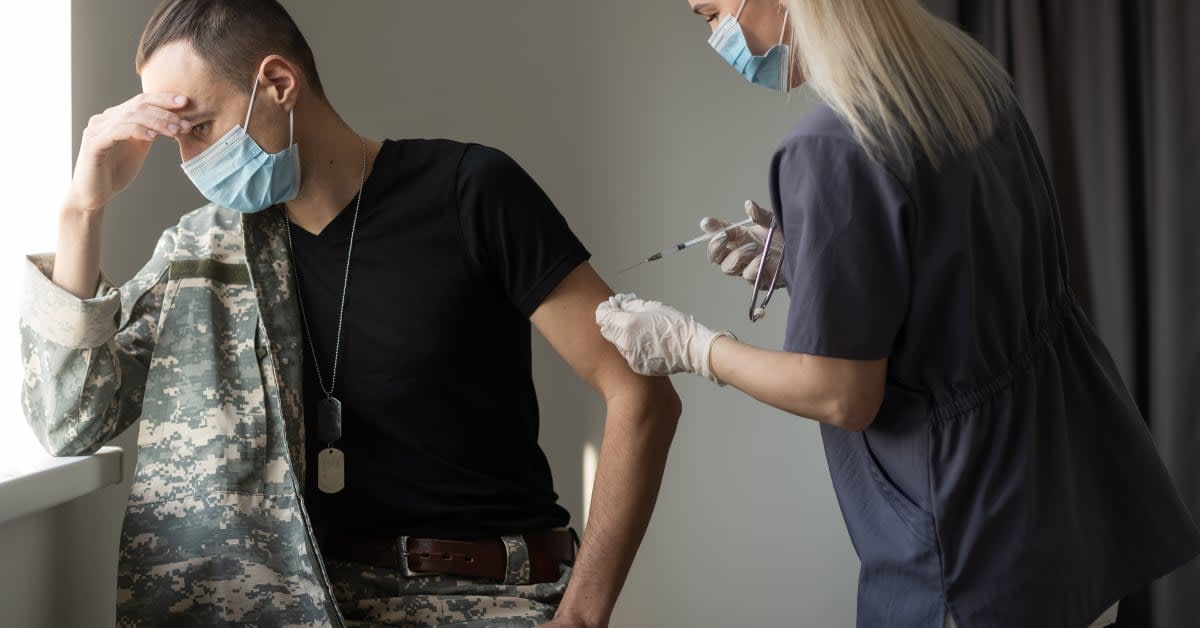
Military-Specific Considerations
- Deployments & Readiness: Vaccine accommodations are evaluated in light of mission requirements. Even when an accommodation is granted, duty assignments, deployment status, and location-based requirements can affect how the accommodation is applied and whether any approval is rescinded.
- Temporary, Changeable Outcomes: Most approvals for religious accommodation are temporary or subject to review and rescission when circumstances change (new duty station, deployment, job role).
- Veterans and Record Corrections: Former service members may be able to pursue discharge upgrades or record corrections when vaccine-related actions resulted in unfair or disproportionate outcomes.
BOOK 30 MINUTE CONSULTATION HERE
($200 Consultation Fee)
Frequently Asked Questions
Should I request a religious accommodation from multiple vaccines in the same request?
Usually, no. A common best practice is to address one vaccine requirement per request when the branch’s process and timing make that appropriate. Combining multiple vaccines into one request can create avoidable issues and dilute clarity.
What about conscientious objector (CO) status?
CO status is a separate process and is not a substitute for a vaccine accommodation request. Vaccine accommodation requests must be grounded in a religious belief or medical contraindication tied to the vaccination requirement at issue.
Will requesting a religious accommodation itself cause problems?
Requesting an accommodation is not the same as refusing an order. It is common practice, and explicitly stated in some service regulations, that a temporary exemption is granted while a service member’s request for accommodation is pending.
Do I have to explain why I didn’t object with a religious exemption earlier?
Not necessarily. The question is whether the belief is sincere and whether the vaccine requirement substantially burdens the exercise of that belief.
BOOK 30 MINUTE CONSULTATION HERE
($200 Consultation Fee)
Contact Us
Contact Siri & Glimstad for confidential legal advice. We understand military procedures and are prepared to help you navigate the vaccine accommodation process. We can help you submit a clear, individualized request and respond effectively if your command asks follow-up questions or issues a denial. Book a consultation today.
BOOK 30 MINUTE CONSULTATION HERE
($200 Consultation Fee)

Content Reviewed by: Wendy Cox – Military Vaccine Exemption Lawyer
Before joining Siri & Glimstad, Wendy served 21 years in the United States Army as both an Army Nurse Corps officer and a Judge Advocate. During her military career, she worked in a variety of clinical settings as a nurse and provided legal counsel to senior military leaders on matters including operational law, criminal law, and health care law. While serving as a JAG, she also taught Constitutional Law at West Point. After leaving active duty in 2018, Wendy continued supporting soldiers as an attorney with the Office of Soldiers’ Counsel. She earned her J.D., cum laude, from the State University at Buffalo Law School; a B.S.N., summa cum laude, from Norwich University; and an LL.M. in Military Law.
This page was last updated on: March 10th, 2026
Contact Us
BOOK 30 MINUTE CONSULTATION HERE
($200 Consultation Fee)


